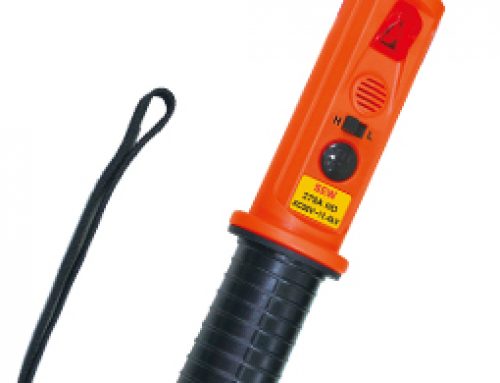
SLT 5.0超声波液位和流量监测仪
- 测量水平或开放通道流量
- 用户友好的校准系统
- 隔离4-20mA(1000欧姆)
- 虚假的回声拒绝
- 2个可编程控制继电器
- 电涌保护
- 本安型传感器选件
- 即插即用继电器和数据记录器选项
SLT 5.0 Ultrasonic Level & Flow Monitor
- Measure Level or Open Channel Flow
- User-Friendly Calibration System
- Isolated 4-20mA (1000 ohm)
- False Echo Rejection
- 2 Programmable Control Relays
- Electrical Surge Protection
- Intrinsically Safe Sensor Option
- Plug and Play Relay and Data Logger Options
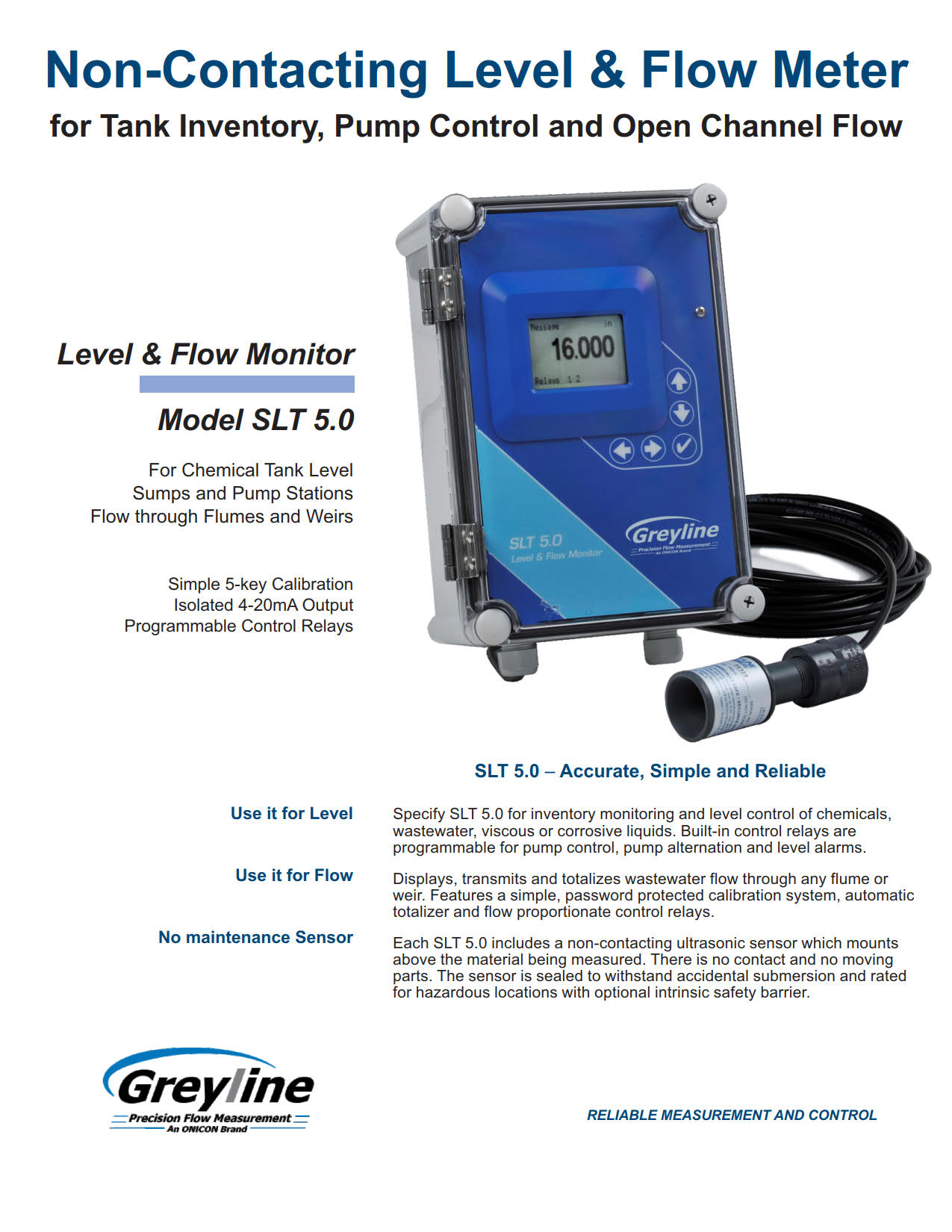
SLT 5.0水平和流量监视器
使用这种多功能仪器连续测量,显示,传输和控制储罐和泵站中的液位,或监测和总计通过水槽或堰的明渠流量。将非接触式超声波传感器安装在被测液体上方,并在附近安装防水电子设备外壳。具有用户友好的键盘校准系统,背光LCD显示屏,隔离的4-20mA输出和2个可编程控制继电器。
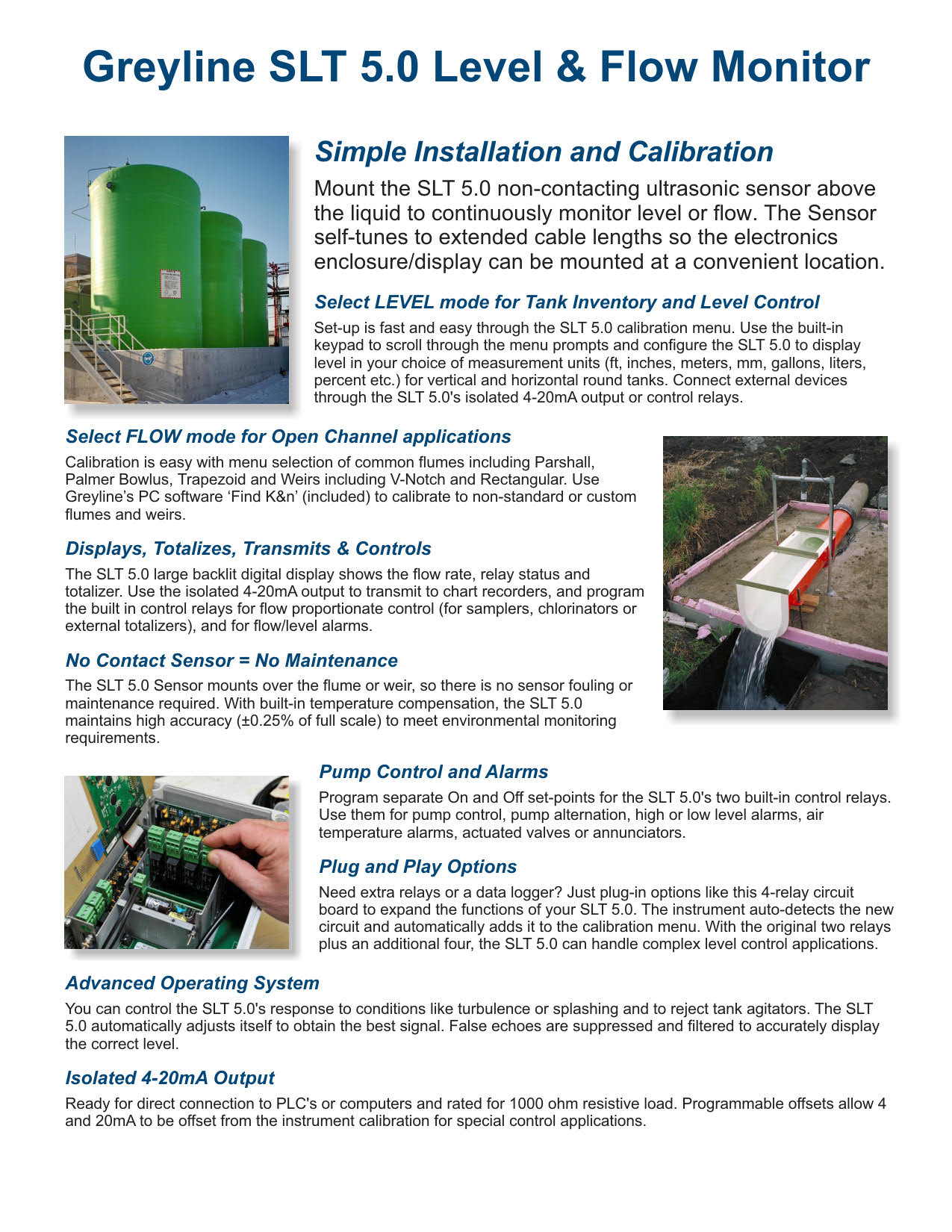
使用内置的5键键盘可轻松进行校准。SLT 5.0提供简单的测量单位菜单选择(加仑,升等),计算水平圆形水箱的容积,或通过任何水槽或堰流量(和总量)。
对于危险场所,超声波传感器的额定本质安全,带有可选的安全栅。标准PVC和Teflon传感器的额定测量范围可达32英尺/ 10米,或选择可选的传感器用于法兰安装或需要更长测量范围的应用。选项包括4个额外的控制继电器(总共6个)和一个内置的200万点数据记录器,USB输出到闪存棒。
SLT 5.0 Level & Flow Monitor
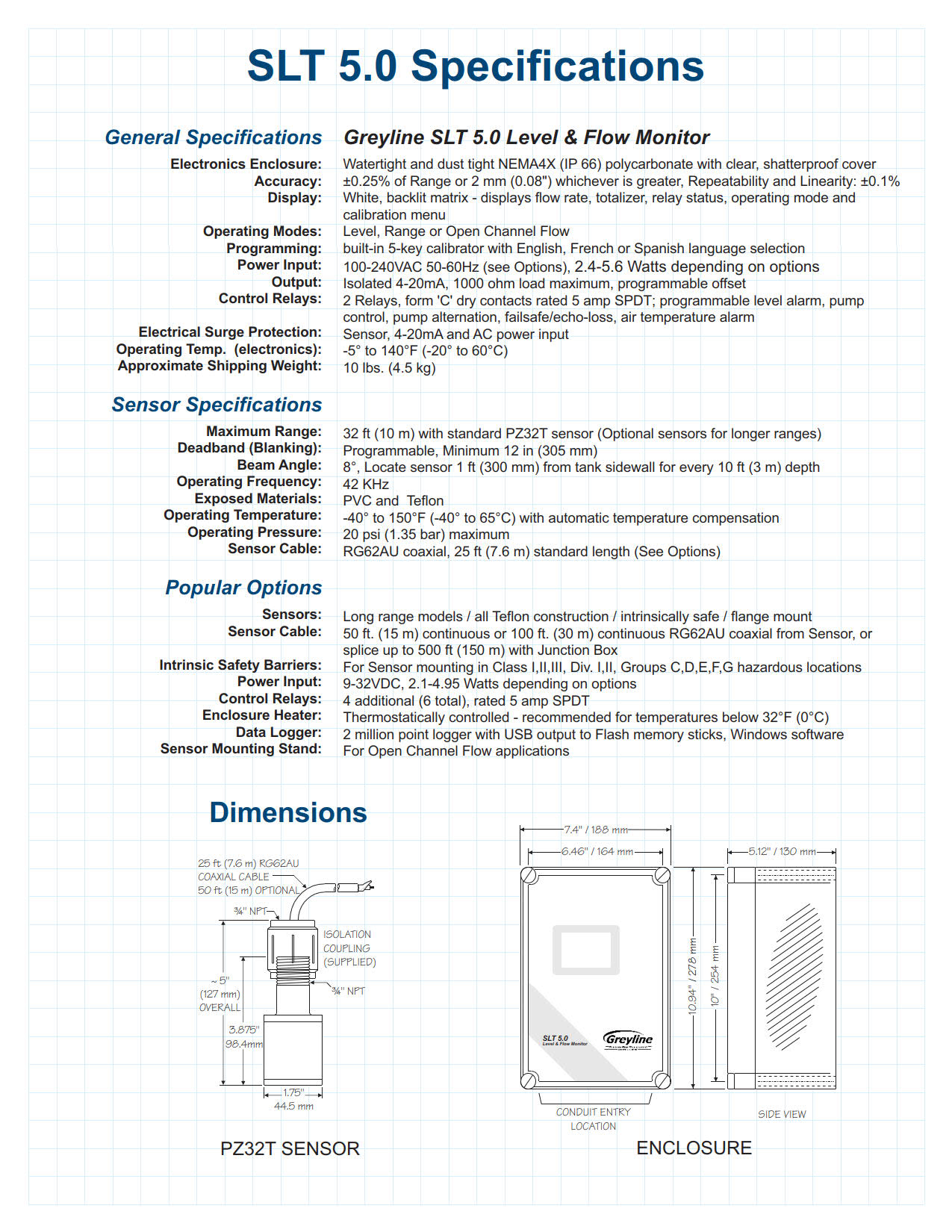
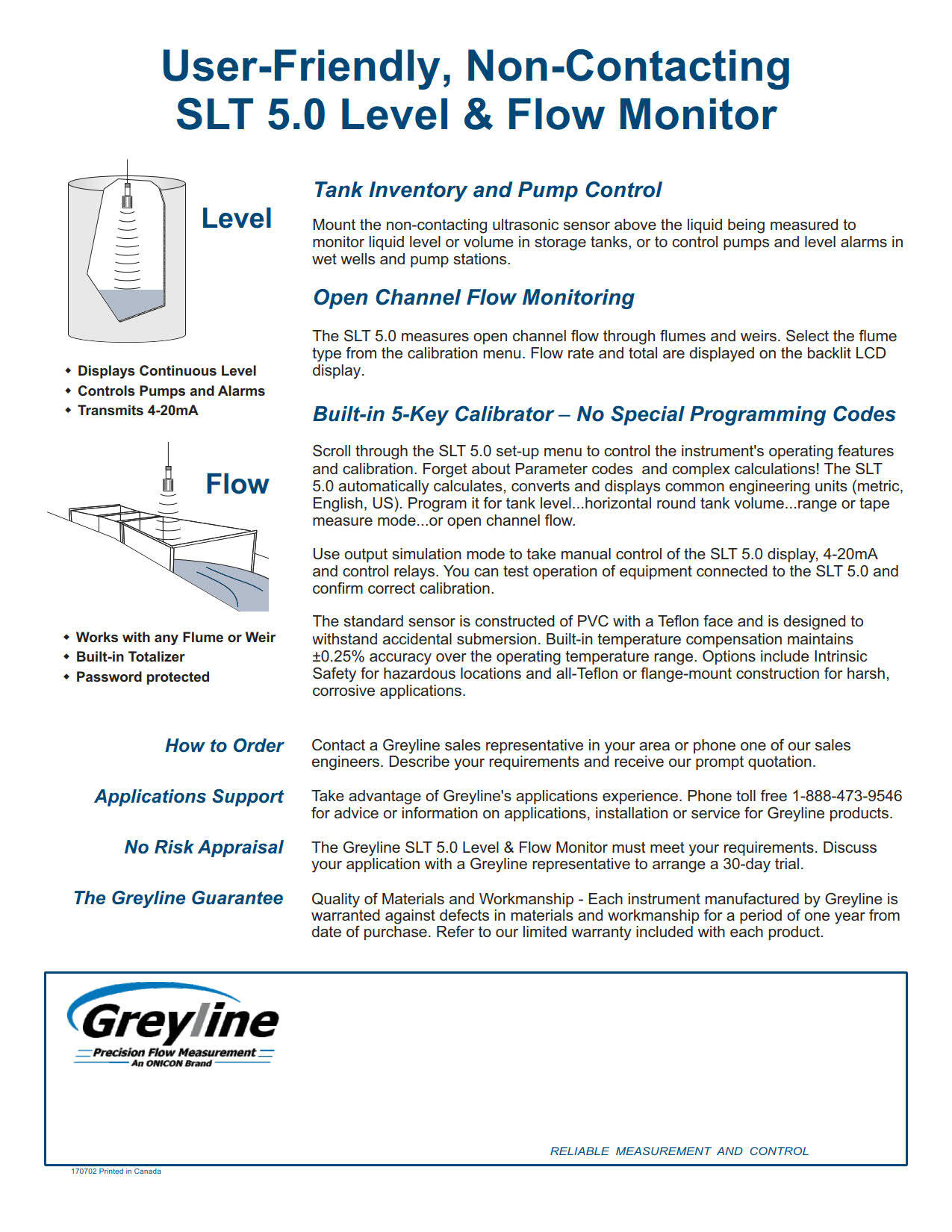
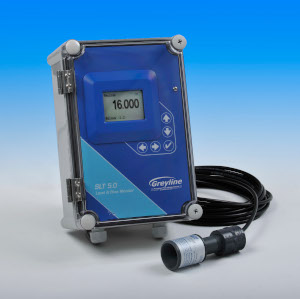
Use this versatile instrument to continuously measure, display, transmit and control liquid level in storage tanks and pumping stations, or to monitor and totalize Open Channel Flow through any flume or weir. Mount the non-contacting ultrasonic sensor above the liquid being measured and install the watertight electronics enclosure nearby. Features a user-friendly keypad calibration system, backlit LCD display, an isolated 4-20mA output and 2 programmable control relays.
Calibration is easy with the built-in 5 button keypad. The SLT 5.0 offers simple menu selection of measurement units (gallons, liters etc.), calculates volume in horizontal round tanks, or flow rate (and total) through any flume or weir.
For hazardous locations, the ultrasonic sensor is rated Intrinsically Safe with an optional safety barrier. The standard PVC and Teflon Sensor is rated for measurement ranges up to 32 ft/10 m, or select optional sensors for flange-mount or applications requiring longer measurement range. Options include 4 additional control relays (6 total) and a built-in 2-million point Data Logger with USB output to Flash memory sticks.
液位和流量监测器规范
范围:本规范涵盖由Greyline Instruments,Largo,Florida/Long Sault,Ontario制造的非接触式超声波液位/流量监测器。
该仪器应能够指示、传输和控制容器中的材料水平或目标与仪器传感器的接近程度,并通过水槽、堰或其他主要测量装置指示、传输和合计流量。
A.通用
液位/流量监测器由非接触式超声波传感器、连接电缆和带有指示、传输和控制电子设备的远程外壳组成。
测量精度应为量程的±0.25%或2 mm(0.08”),以较大者为准,并应自动进行温度补偿。
传感器电缆长度应符合安装要求,不得超过500’(152 m)。
系统应无活动部件,且不得接触被测材料。
应包括PC软件程序盘,以确定非标准水槽和堰的明渠流量校准值。
B.传感元件
传感器应采用PVC和特氟龙制成。
传感器的最小死区或空白区应为12”(305 m m),最大范围为32 ft.(10 m),工作频率为42 kHz,超声波束角为8度。
传感器应能承受20 psi的意外淹没。
传感器工作温度应为-40°F至150°F(-40°C至65°C)。
传感器应包括整体式温度传感器。
不接受需要单独安装和布线的温度传感器。
C.传感器连接电缆
提供连续长度为25英尺(7.6米)的RG62AU同轴电缆,并在传感器头上进行防水封装连接。
延伸传感器电缆应为RG62AU同轴电缆,最大500’(152m)。
电缆应采用制造商推荐的NEMA4钢接线盒中的螺纹终端连接进行拼接。
水平和温度信号应在一根同轴电缆上进行。
不接受单独或多芯电缆。
传感器电缆应安装在接地金属导管中。
D.发射机
变送器
应通过内置5键校准系统进行现场校准,并选择参数菜单。
不接受通过参数代码、BCD开关或外部校准器进行校准的系统。
校准数据应受到密码保护,并通过断电永久存储至少12个月。
现场校准应允许选择和自动转换测量单位、测量范围和控制继电器。
变送器应在用户选择的范围、液位或明渠流量模式下进行现场校准。
流量模式应允许对普通一次计量装置进行校准,并允许输入非标准水槽、堰或明渠的校准公式。
变送器应允许现场可编程阻尼,以使湍流水平的输出平滑。
变送器工作温度应为-5°至140°F(-20°至60°C)。
变送器应包含一个恒温控制的外壳加热器,用于30°F(-1°C)以下的冷凝保护。
变送器应具有隔离的4-20mA输出,额定最大负载为1000 ohm,可选择菜单0-5 Vdc替代。
提供两个继电器触点,额定5安培SPDT,可编程用于单设定点报警、双设定点泵控制、泵交替、温度报警、流量积算器脉冲和/或回波损耗报警。
提供一个白色背光矩阵LCD显示屏,以用户选择的工程单位显示流量、液位、速度、积算器和继电器状态。
显示液位或流量、校准单位、累加器和继电器状态的变送器显示应可见,无需打开盖子。
变送器应安装在壁装式防水NEMA4X(IP66)外壳内,并配有铰链式透明盖。
应包括安装硬件。
应在交流电源输入、传感器和4-20mA输出端对变送器电子设备进行浪涌保护。
变送器电源输入应为100-240VAC 50-60Hz,功耗不超过3.5瓦。
变送器应允许插入式现场安装和自动检测可选附件,包括数据记录器和附加控制继电器。
E.根据需要插入的可选功能
有4个附加(共6个)控制继电器,额定5安培SPDT,可编程用于单设定点报警、双设定点泵控制、泵交替、温度报警、流量积算器脉冲和/或回波损耗报警。
传感器、连接电缆和接线盒的本质安全等级应为I、II、III级,I、II类,C、D、E、F、G组。
有一个恒温控制的外壳加热器,用于温度低于冰点时的变送器操作。
当通过批准的安全屏障连接时,应具有PZ32TE型全特氟隆传感器,其额定本安性为-40°F至170°F(-40°C至76°C)。
有一个pvc和特氟隆传感器型号pz56,适用于高达50英尺(15.6米)的液体测量范围。
具有一个聚四氟乙烯面法兰安装传感器型号PZ34TXF,额定测量范围为32英尺(10米)。
指定法兰尺寸为4“或6”。
使用制造商推荐的外壳防晒霜,以便在阳光直射下安装变送器。
使用制造商推荐的传感器防晒霜,以便在阳光直射下安装温度补偿传感器。
为外壳安装提供制造商推荐的面板安装法兰组件。
内置200万点数据记录器,USB输出到闪存驱动器或大容量存储设备。
包括Windows软件。
电源输入为9-32Vdc,功耗小于3.5瓦。
F.制造商
液位/流量监测器应为Greyline Instruments Inc.制造的SLT 5.0型,并应保证一年内不会出现材料和工艺缺陷。
规格如有更改,恕不另行通知。如果您在申请中需要更多信息或建议,请联系Greyline。我们可以提供报价,并向贵公司所在地区的Greyline销售代表咨询。
LEVEL & FLOW MONITOR SPECIFICATIONS
SCOPE: This specification covers a non-contacting ultrasonic Level/Flow Monitor as manufactured by Greyline Instruments, Largo, Florida / Long Sault, Ontario. This instrument shall provide for indicating, transmitting and control of the material level in a vessel or proximity of a target to the instrument sensor, and indicating, transmitting, and totalizing of the flow rate through a flume, weir, or other primary measuring device.
A. GENERAL
Level/Flow Monitor to consist of an non-contacting ultrasonic sensor, connecting cable, and a remote enclosure with indicating, transmitting and controlling electronics.
Measurement accuracy shall be ±0.25% of Range or 2 mm (0.08″), whichever is greater, and shall be automatically temperature compensated.
Sensor cable length shall be as required by installation, not to exceed 500′ (152 m).
System shall have no moving parts and shall not contact the material being measured.
Shall include PC software program disk to determine open channel flow calibration values for non-standard flumes and weirs.
B. SENSING ELEMENT
Sensor shall be constructed of PVC and Teflon.
The sensor shall have a minimum deadband or blanking of 12″ (305 mm) and a maximum range of 32 ft. (10 m), and have an operating frequency of 42 kHz with an ultrasonic beam angle of 8 Degrees.
Sensor shall withstand accidental submersion to 20 psi.
Sensor operating temperature shall be from -40°F to 150°F (-40°C to 65°C).
Sensor shall include integral temperature sensor. Temperature sensors requiring separate mounting and wire runs shall not be accepted.
C. SENSOR CONNECTING CABLE
Provide RG62AU coaxial cable 25′ (7.6m) continuous length, with waterproof, potted bond to the Sensor head.
Extended sensor cable shall be RG62AU coaxial to a maximum of 500′ (152m). Cable shall be spliced with screw terminal connections in manufacturer’s recommended steel NEMA4 Junction Box.
Level and temperature signals shall be conducted on one single coaxial cable. Separate or multiple-conductor cables shall not be accepted.
Sensor cable shall be installed in grounded metal conduit.
D. TRANSMITTER
The transmitter shall provide for field-calibration via built-in 5-key calibration system with menu selection of parameters. Systems requiring calibration by Parameter codes, BCD switches or external calibrators shall not be accepted.
Calibration data shall be password protected and permanently stored through power interruptions for a minimum of 12 months.
Field calibration shall allow selection and automatic conversion of measurement units, measurement span and control relays.
The transmitter shall provide for field calibration in user-selected Range, Level or Open Channel Flow modes. Flow mode shall allow calibration to common primary metering devices, plus allow entry of calibration formula for non-standard flumes, weirs or open channels.
Transmitter shall permit field programmable damping to smooth output with turbulent level.
Transmitter operating temperature shall be from -5° to 140°F (-20° to 60°C). Transmitter shall contain a thermostat-controlled enclosure heater for condensation protection below 30°F (-1°C).
Transmitter shall have an isolated 4-20mA output rated for 1000 ohm maximum load with menu-selectable 0-5VDC alternative.
Provide two relay contacts rated 5 amp SPDT programmable for single set point alarms, dual set point pump control, pump alternation, temperature alarm, flow totalizer pulse and/or echo loss alarm.
Provide a white, backlit matrix LCD display indicating flow rate, level, velocity, totalizer and relay states in user-selected engineering units.
Transmitter display indicating level or flow rate, units of calibration, totalizer and relay states shall be visible without opening cover.
Transmitter shall be housed in a wall-mount, watertight NEMA4X (IP66) enclosure with hinged, clear cover. Mounting hardware shall be included.
Transmitter electronics shall be surge protected on AC power input, sensor and 4-20mA outputs.
Transmitter power input shall be 100-240VAC 50-60Hz with power consumption of 3.5 Watts or less.
The transmitter shall permit plug-in field installation and auto-detection of optional accessories including data logger and additional control relays.
E. OPTIONAL FEATURES FOR INSERTION AS REQUIRED
Have 4 additional (6 total) control relays, rated 5 amp SPDT and programmable for single set point alarms, dual set point pump control, pump alternation, temperature alarm, flow totalizer pulse and/or echo loss alarm.
Sensor, connecting cable and junction boxes shall be rated intrinsically safe to Class I,II,III, Div. I,II, Groups C,D,E,F,G.
Have a thermostat controlled enclosure heater for Transmitter operation at temperatures below freezing.
Have an all-Teflon sensor Model PZ32TE rated intrinsically safe when connected through an approved safety barrier, and rated for operation from -40°F to 170°F (-40°C to 76°C).
Have a PVC and Teflon sensor Model PZ56 rated for measurement range on liquids up to 50 ft. (15.6 m).
Have a Teflon-faced flange mount sensor model PZ34TxF rated for 32 ft (10 m) measurement range. Specify flange size of 4” or 6”.
Have manufacturer’s recommended enclosure sunscreen to permit Transmitter mounting in direct sunlight.
Have manufacturer’s recommended Sensor sunscreen to permit temperature-compensated Sensor mounting in direct sunlight.
Have manufacturer’s recommended Panel Mount Flange assembly for enclosure installation.
Have a built-in 2 million point Data Logger with USB output to flash drive or mass storage device. Include Windows software.
Have power input of 9-32VDC and power consumption of less than 3.5 Watts.
F. MANUFACTURER
Level/Flow Monitor shall be Model SLT 5.0 as manufactured by Greyline Instruments Inc. and shall be warranted against defects in materials and workmanship for one year.
Specifications are subject to change without notice. Please contact Greyline if you need more information or for advice in your application. We can provide quotations and refer you to the Greyline sales representative in your area.
流量计运作原理
仪器电子设备测量从发送声音到回声返回所需的时间。根据空气中的声速,可以高精度计算出液体表面与传感器的准确距离(0.25%范围)。
由于声速受空气温度的影响,灰线超声波液位传感器包括一个内置的温度传感器。水平/距离测量在传感器的整个工作温度范围内自动进行温度补偿。
传感器的位置应使其能清楚地“看到”液体表面,远离梯子、管道或其他障碍物。Greyline建议每10英尺深度距离侧壁1英尺(每3米深度300毫米)。来自搅拌器的假回波(在传感器下扫过)、湍流和波可以被仪器过滤和忽略。
Greyline模型的范围从简单的4-20mA液位指示发送器,到复杂的监控、控制和数据记录模型。返回greyline产品了解级别模型详细信息和规格。有关包括超声波在内的各种液位仪表技术的信息,请参阅废水液位测量技术。
测量管外脏污或充气液体的流量
多普勒效应由奥地利物理学家克里斯蒂安·多普勒于1842年提出。我们每天都能听到多普勒的例子:火车经过时的汽笛声改变音调,或者赛车驶过我们的位置时的排气噪音。
多普勒技术只适用于含有固体或气泡的液体来反射其信号。这些是“困难”的液体,可能会损坏常规流量计:泥浆、污泥、废水、磨料、粘性和腐蚀性化学品。由于传感器安装在管道外部,因此没有压降,也没有流动障碍物。
为了获得很好性能,多普勒传感器应安装在远离湍流产生装置(如弯管和三通)的地方,远离速度增加装置(如控制阀和泵)。典型精度为满刻度的±2%。多普勒仪器包括一个夹式超声波传感器、连接电缆和一个电子外壳,可以安装在附近方便的位置(500英尺/152米范围内)。传感器可以本质安全地额定安装在危险的额定位置。
需要非常精确的定时电路,但当传感器可以安装在流量均匀分布的管段上时,1%的精度非常典型。
由于超声波信号必须穿过管道到达接收传感器,因此流体中不得含有大量气泡或固体(小于2%)。否则高频声音会减弱,太弱,无法穿过管道。应用包括饮用水、冷却水、水/乙二醇溶液、液压油、燃油和化学品。
渡越时间传感器通常工作在1-2兆赫的频率。高频设计通常用于较小的管道,低频设计用于直径达数米的大型管道。
水槽和堰是专门设计的渠道形状,以表征水流。常见的类型有矩形堰、V型槽堰、Parshall水槽和Palmer Bowlus水槽。水槽或堰型的选择取决于应用:流速、渠道形状和水的固体含量。请联系Greyline Instruments以获取有关为您的应用选择合适水槽或堰的建议。
灰线明渠流量计可以通过菜单选择校准到水槽或堰。明渠流量计电子设备使用内部公式计算流量(流量=k h n,其中“k”和“n”为常数,“h”为仪器测量的压头)。通过直接输入“k”和“n”常数,可以对不常见或自定义水槽进行校准。Greyline还提供了一个PC软件程序“find k&n”,用于根据水槽或堰流图开发校准常数。
Greyline明渠流量计包括非接触式超声波传感器、连接电缆和电子外壳,可安装在附近方便的位置(500 ft/152 m内)。传感器可以本质安全地额定安装在危险的额定位置。仪器显示、汇总、传输和控制,有些型号包括数据记录/流量报告系统。
在没有水槽或堰的情况下测量明渠流量。面积速度流量计连续测量水位和流速,以计算明渠或管道中的流量。
超声波传感器安装在管道或通道的底部。为了测量水位,传感器发送超声波脉冲,这些脉冲通过水传播并从液体表面反射出来。仪器精确测量回声返回传感器所需的时间。根据水中声速,测量声级精度为±0.25%。
用连续注入水中的超声多普勒信号测量流速。这种高频声音(640kHz)从悬浮在液体中的颗粒或气泡反射回传感器。如果流体在运动,回声以与流速成比例的变化频率返回。利用该技术,仪器测量流速的精度为±2%。
greyline面积流速流量计工作在部分满管和溢流管、矩形、梯形和蛋形通道中。
可选-单独的液位和速度传感器
一个单独的向下看超声波传感器可用于高充气或湍流应用。它通过将超声波脉冲通过空气传输到液体表面来测量液位,精度为±0.25%。在水位传感器的基础上,采用水下多普勒速度传感器对水位进行测量。
HOW IT WORKS
The instrument electronics measure the time it takes from transmitted sound to return of the echo. With reference to the speed of sound in air, the exact distance of the liquid surface from the sensor can be calculated with high accuracy (±0.25% of maximum range).
Since the speed of sound is affected by air temperature, Greyline ultrasonic level sensors include a built-in temperature sensor. Level/distance measurements are automatically temperature compensated throughout the operating temperature range of the sensor.
The sensor should be positioned so that it has a clear “view” of the liquid surface and away from ladders, pipes or other obstructions. Greyline recommends 1 ft. from the sidewall for every 10 ft. depth (300 mm for every 3 m depth). False echoes from agitators (sweeping under the sensor), turbulence and waves can be filtered and disregarded by the instrument.
Greyline models range from simple 4-20mA level indicating transmitters, to sophisticated monitoring, controlling and data logging models. Return to Greyline Products for Level model details and specifications. For information on a wide range of level instrument technologies including ultrasonics, read Wastewater Level Measurement Techniques.
Doppler flow meters measure flow from outside a pipe with a clamp-on sensor. Greyline Doppler meters continuously transmit high frequency sound (640 kHz) that travels through the pipe wall and into the flowing liquid. Sound is reflected back to the sensor from solids or bubbles in the fluid. If the fluid is in motion, the echoes return at an altered frequency proportionate to flow velocity. Doppler flow meters continuously measure this frequency shift to calculate flow.
Measure Flow of dirty or aerated Liquids from Outside a Pipe
The Doppler effect was first documented in 1842 by Christian Doppler, an Austrian physicist. We hear everyday examples of Doppler: the sound of a train whistle changing pitch as it passes by, or the exhaust noise from a race car as it speeds past our location.
The Doppler technique only works on liquids which contain solids or gas bubbles to reflect its signal. These are “difficult” liquids that may damage regular flow meters: slurries, sludge, wastewater, abrasives, viscous and corrosive chemicals. Because the sensor mounts on the outside of the pipe, there is no pressure drop and no obstruction to flow.
For best performance Doppler sensors should be mounted away from turbulence creating devices like pipe elbows and tees, and away from velocity increasing devices like controlling valves and pumps. Typical accuracy is ±2% of full scale. Doppler instruments include a clamp-on ultrasonic sensor, connecting cable and an electronics enclosure which can be mounted at a convenient location nearby (within 500 ft / 152 m). Sensors can be rated intrinsically safe for mounting in hazardous-rated locations.
Very accurate timing circuits are required but 1% accuracy is quite typical when the transducers can be mounted on a pipe section with evenly distributed flow.
Because the ultrasonic signal must cross the pipe to a receiving transducer, the fluid must not contain a significant concentration of bubbles or solids (less than 2%). Otherwise the high frequency sound will be attenuated and too weak to traverse the pipe. Applications include potable water, cooling water, water/glycol solutions, hydraulic oil, fuel oils and chemicals.
Transit Time transducers typically operate in the 1-2 MHz frequencies. Higher frequency designs are normally used in smaller pipes and lower frequencies for large pipes up to several meters in diameter.
Flumes and weirs are specially designed channel shapes that characterize the flow of water. Common types are Rectangular Weirs, V-Notch Weirs, Parshall flumes and Palmer Bowlus flumes. The choice of flume or weir type depends on the application: flow rate, channel shape and solids content of the water. Contact Greyline Instruments for advice on selection of a suitable flume or weir for your application.
Greyline open channel flow meters can be calibrated to any flume or weir by menu selection. The open channel flow meter electronics use an internal formula to calculate flow rate (Flow = K Hn, where ‘K’ and ‘n’ are constants and ‘H’ is Head as measured by the instrument). Calibration to uncommon or custom flumes can be done by direct entry of ‘K’ and ‘n’ constants. Greyline also offers a PC software program “Find K&n” to develop calibration constants from a flume or weir flow chart.
Greyline open channel flow meters include a non-contacting ultrasonic sensor, connecting cable and an electronics enclosure which can be mounted at a convenient location nearby (within 500 ft / 152 m). Sensors can be rated intrinsically safe for mounting in hazardous-rated locations. The instruments display, totalize, transmit and control, and some models include data logging/flow reporting systems.
Measure open channel flow without a flume or weir An Area-Velocity Flow Meter continuously measures both Level and Velocity to calculate flow volume in an open channel or pipe.
The ultrasonic sensor is installed at the bottom of a pipe or channel. To measure water level the sensor transmits ultrasonic pulses that travel through the water and reflect off the liquid surface. The instrument precisely measures the time it takes for echoes to return to the sensor. Based on the speed of sound in water, the level is measured with accuracy of ±0.25%.
Flow velocity is measured with an ultrasonic Doppler signal continuously injected into the water. This high frequency sound (640 KHz) is reflected back to the sensor from particles or bubbles suspended in the liquid. If the fluid is in motion, the echoes return at an altered frequency proportionate to flow velocity. With this technique the instrument measures flow velocity with accuracy of ±2%.
Greyline Area-Velocity Flow Meters work in partially full and surcharged pipes, rectangular, trapezoid and egg-shaped channels.
Optional – Separate Level and Velocity Sensors
A separate down-looking ultrasonic sensor can be used for highly aerated or turbulent flow applications. It measures level by transmitting ultrasonic pulses through the air to the liquid surface with accuracy of ±0.25%. Along with the level sensor, a submerged Doppler velocity sensor is used to measure the water velocity.