便携式变压器比率计型号4167F-(CVT)
特征
- 比率范围从0.75到20,000(与CVT-Ext的比率更高)
- 全自动测量
- 具有Vector Group Detection
- 测量电压范围为8 V至230 V.
- 通过CVT扩展测量高达5 kV的电压:4167F-(CVT)
- 使用3相电压用于0°/ 180°以外的相位角
- 易于操作的自动分接开关
- 内部存储器存储所有日期(使用4167F-(CVT)-XFER读取)
- 带背光的液晶显示屏(256 x 128像素)
- 轻松输入矢量组和测量条件
- USB / RS232C端口可获得全面的仪器控制
- Centronics打印机端口或内置打印机(可选)
- 坚固的移动外壳,适合野外使用
- 工厂证书
4167F-(CVT)的优势在于其简单的设置。
在大多数情况下,必须根据矢量组和要测量的变压器的代码编号在表格中查找所需的参数,并通过旋转开关或键在仪器上进行设置。这通常会导致设置错误或设置不确定,因为有些表格令人困惑。
使用4167F-(CVT)变比测量仪器不需要这样的手动设置。您只需使用键输入向量组。您需要做的就是将离线变压器连接到设备并释放测量值;?连续测量所有三相,在每次测量之前自动执行初级和次级电压侧的所有连接和短路程序。当然,也可以仅测量一个相,例如。H2。
可调节的设定值允许显示测量的变比的误差或偏差。此外,提供了抽头变换器的自动控制。在这种情况下,所有相位和分接头都是连续测量的,所有结果都存储在仪器内(使用变压器专用存储器),打印(如果连接了打印机),并传输到PC(如果已连接)。
使用内部存储器将所有抽头的所有结果写入变压器特定区域。此外,当选择并显示在LCD上时,变压器特定设定值,矢量组和描述变压器的附加信息(例如序列号,位置……)将从存储器中读出。如果存在设定值,则显示带有相应信息的OK / NOT OK消息。
变压器专用数据可以通过连接的个人计算机轻松编程,但也可以通过内部键盘输入变压器专用数据。
4167F-(CVT)变比测量仪通过每个四个连接连接到HV和LV侧。它还以选定的电压为测试对象供电,由内部隔离变压器供电。然而,使用不同电压和频率的外部激励也是可能的。
一个特殊功能是可以使用三相测量电压。变压器具有n * 30°的相位角,其中n是向量编号0到11.因为所有测量都是单相,所有结果也将是0°或180°以及最终的相位误差。
但是有一些特殊的变压器的相角为n * 30°±(0°..15°),例如127.5°。要获得该值(而不是0/180°),需要三相电源为变压器供电。为此目的使用三相线电压。
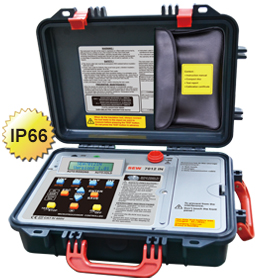
4167F-(CVT)采用坚固的便携箱供货。所有连接均在仪器前部提供并锁定,以避免在测量过程中拔出插头。还可以提供警报设置(测量期间红色指示灯亮)。
连接电缆和夹具在HV绕组上为4极(开尔文),以避免由于电缆电阻引起的误差。
Features
- Ratio range from 0.75 to 20,000 (higher ratios with CVT-Ext.)
- Fully automated measurement
- Features market unique Vector Group Detection
- Measuring voltage from 8 V to 230 V
- Measuring voltage up to 5 kV by CVT-Extension: 4167F-(CVT)
- Using 3-phase voltage for phase angles other than 0°/180°
- Easy to handle tap changer automatic
- Internal memory stores all dates (Reading with 4167F-(CVT)-XFER)
- LC display (256 x 128 pixel) with backlight
- Easy input of vectorgroup and measuring conditions
- USB/RS232C port to get full instrument control
- Centronics printer port or build in printer (optional)
- Robust mobile case for field use
- Factory Certificate
The great advantage of the 4167F-(CVT)? is its simple set-up.
In most cases the required parameters must be looked?up in tables on the basis of the vector group and the?code number of the transformer to be measured, and?set up at the instrument by means of rotary switches or?keys. This often results in a wrong set-up or uncertainty?regarding the set-up since some of the tables are?confusing.
Such a manual set-up is not necessary with the 4167F-(CVT) transformation ratio measuring instrument. You?simply type in the vector group with the keys.?The only thing you have to do is to connect the?transformer being off-line to the device and release the?measurement; all three phases are measured?consecutively, all connecting and short circuited?procedures at the primary and secondary voltage sides?are performed automatically before each measurement.?Of course it is also possible to measure just one phase,?e g. H2.
An adjustable set value permits the display of an error?or deviation of the measured transformation ratio.?Further, an automatic control of the tap changer is?provided. In this case all phases and taps are measured?consecutively, and all the results are stored inside the?instrument (using the transformer specific memory),?printed (if a printer is connected), and transferred to the?PC (if connected).
Using the internal memory all results for all taps are?written to a transformer specific area.?Furthermore, the transformer specific set point values,?the vector group and additional information describing?the transformer (e.g. serial number, location …) are read?from the memory when selected and displayed on the?LCD. If set point values are present, an OK / NOT OK?message with the corresponding information is?displayed.
The transformer specific data can be easily?programmed via a connected personal computer but it?is also possible to input the transformer specific data via?the internal keyboard.
The 4167F-(CVT) transformation ratio measuring?instrument is connected to the H.V. and L.V. sides via?four connections each. It also powers the test object at?selected voltage, supplied by an internal isolating ?transformer. However, an external excitation using different?voltages and frequencies is also possible.
A special feature is the possibility to use three phase measuring?voltage. Transformers have phase angles of n*30° where n is?the vector number 0 to 11. Because all measurements are single?phase all results will be 0° or 180° too together with eventually?phase errors.
But there are some special transformers with phase angles of?n*30° ± (0°..15°), e.g. 127.5°. To get this value (and not 0/180°)?one need a three phase source to feed the transformer. A 3-phase line voltage is used for this purpose.
The 4167F-(CVT) is supplied in a robust carrying case. All?connections are provided at the front of the instrument and are?locked in order to avoid unplugging during a measurement. An?alarm set (a red lamp is on during the measurement) can also?be supplied.
The connecting cables and clamps are 4-pole (Kelvin) on the?HV-winding to avoid errors due to cable resistance.